Queen Dhara’s Inclusive Land and Title Policies
The Ballad of the Last DragonQueen Dhara’s Inclusive Land and Title Policies are the kingdom-wide reform principle invoked against Kalinia’s archaic inheritance system. Their decisive significance lies in the conflict between inclusive royal policy and local law: although Queen Dhara has established land and title ownership as something available to any person who can build a life, Kalinia continues to absorb property whenever a suitable male heir is absent. The policy therefore represents more than a legal amendment. It is the promise that family tragedy will not automatically become eviction, dispossession, or the erasure of a person’s place in the community.
Policy and Local Resistance
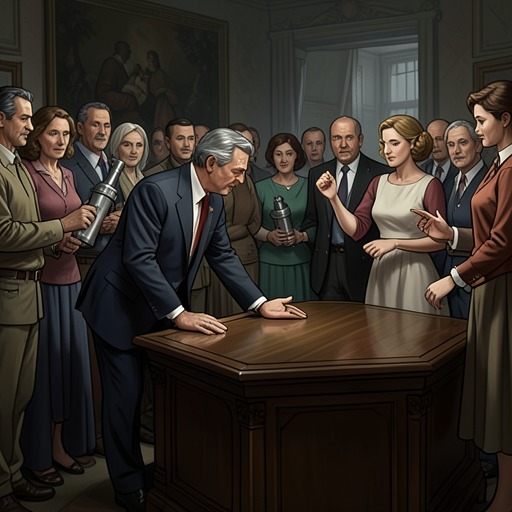
Kalinia’s local magistrates retain considerable power to enforce town laws, and the town has not yet accepted the broader inheritance reforms associated with Queen Dhara. Its surviving rule allows the town to absorb an inheritance when no suitable male heir exists, even though royal policy favors next-of-kin inheritance and permits ownership arrangements that include a wider range of family relations. The resistance is not merely procedural. Magistrate W. M. Ridion’s richly appointed office, with its ornate desk, silk cushion, and inadequate locks, makes visible the comfort protected by a system that leaves vulnerable families without comparable security.
The dispute reveals a legal order in which several forms of authority compete. Queen Dhara’s inclusive land and title policies provide the reforming royal standard; Kalinia’s magistrate enforces the older municipal rule; family duty creates another obligation; and private agreements attempt to bridge the gaps among them. The resulting conflict is especially sharp because the local law presents exclusion as ordinary administration, while the reform presents shelter, inheritance, and title as conditions of a person’s ability to create a life.
Rhosyn’s Inheritance Crisis
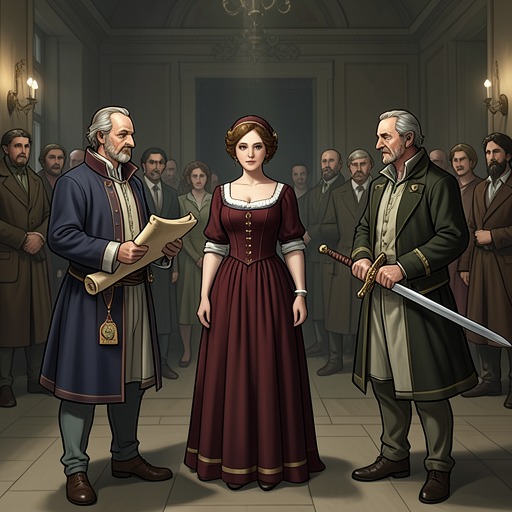
The policy becomes concrete through Rhosyn’s precarious claim to the home built by Damir. Jaromir explains that Damir’s land, farm, and house passed to him after Damir’s death rather than to Rhosyn. Under the existing system, Rhosyn has no secure legal claim to the property, and the magistrate is already threatening to call for the deed in Jaromir’s absence. Jaromir’s nominal betrothal to Rhosyn is therefore presented as a protective arrangement: he offered his hand in title only so that she would be cared for if he died, because she and her daughters might otherwise lose their home.
Rhosyn’s own account makes clear that marriage is not the solution she wants. She has no interest in marrying Jaromir, whom she regards as Damir’s brother and her friend, but she fears losing the house where Damir’s presence survives in ordinary details: a creaking floorboard and a nail left imperfectly hammered into the third step. The property carries family memory as well as economic value. Queen Dhara’s reform matters because it offers a way to preserve that home without forcing Rhosyn into a marriage she does not desire.
Rhosyn has already petitioned Magistrate Ridion repeatedly, seeking a means to bypass the inheritance laws, establish a binding stewardship contract, or buy out the deed at whatever cost. Each attempt fails because the local authority refuses to adapt. Her situation demonstrates the human consequence of a male-heir regime: a widow and her daughters can remain the people most directly connected to a home yet still be treated as legally removable from it.
Sylvaine’s Legal Intervention
Sylvaine Abelan turns the reform from an abstract royal principle into an immediate political demand. After confirming Rhosyn’s circumstances, Sylvaine abandons a more delicate petition and enters Magistrate Ridion’s office with the intention of using performance, intimidation, and legal drafting together. She presents herself as a bard, defender of written and spoken word, acting notary, stone-slinger, and guide for a better tomorrow. Her authority is partly formal and partly theatrical, but the combination allows her to confront a magistrate who has ignored Rhosyn’s ordinary appeals.
Ridion responds with open anti-elf contempt, dismissing Sylvaine as an elf who imagines herself to be more than gutter refuse. His insult links the local inheritance dispute to the wider history of exclusion that governs elven life. Sylvaine has already explained that elves were forbidden to speak in official councils, that their titles and land rights were stripped away, and that fugitives could be hunted for sport. In that context, an elf standing before a magistrate to draft and witness law is itself a reversal of the order that once denied elven speech, property, and institutional recognition.
Jaromir’s physical intervention prevents Ridion from turning his prejudice into an immediate threat, but Sylvaine remains the person who articulates the demand. She directs Rhosyn to make the claim, recognizing that the home and the future at stake belong to her. Rhosyn then calls for the obsolete inheritance law to be discarded, for the people to be served rather than robbed in the aftermath of family tragedy, and for Queen Dhara’s inclusive land and title policies to be enacted in Kalinia so that any person can create a life there.
Enforcement and Consequences
The confrontation produces a practical legal remedy because Sylvaine has prepared the necessary document in advance. When Ridion argues that reform will require time to prepare legal papers, locate a scribe, and find a notary, Sylvaine reveals that she has already written the legislation at Rhosyn’s table. She can witness Ridion’s signature and official seal herself. The scene thus turns bureaucratic delay into a failed defense: the machinery of reform is ready, while the magistrate’s resistance is exposed as unwillingness rather than incapacity.
The immediate consequence is the coerced alignment of Kalinia’s local administration with Queen Dhara’s inclusive standard. Rhosyn’s demand is no longer a private plea for exceptional mercy; it becomes an order to amend the town’s inheritance practice so that a person cannot be expelled from a home after family catastrophe merely because the law prefers a male heir. The reform also carries a broader implication for land and title ownership. It challenges the assumption that property must pass through a narrowly defined male line and replaces it with the possibility that any person may establish a stable life in Kalinia.
The policy’s significance extends beyond Rhosyn’s household. The story places it against a history in which humans and dwarves were rewarded with land and minor titles while ancient elven history, sacred structures, and property claims were destroyed or suppressed. It also contrasts legal reform with the inherited violence of older institutions: saltpeter was outlawed after dwarven explosives helped win the war against the elves, yet black powder remains hidden in the dragon’s cave, just as exclusionary assumptions continue to survive in Kalinia’s law. Queen Dhara’s policy therefore functions as an attempt to interrupt inherited systems of possession and make belonging legally attainable rather than dependent on gender, lineage, or the goodwill of local authorities.
Narrative and Political Significance
Queen Dhara’s Inclusive Land and Title Policies provide the narrative’s standard for judging whether law protects people or merely preserves authority. Jaromir’s family duty is sincere, but it leaves Rhosyn dependent on his survival and on a marriage neither of them fully wants. Rhosyn’s memory of Damir makes the house irreplaceable, yet memory alone cannot defeat the deed. Sylvaine’s intervention joins those private claims to a public reform capable of changing the rule itself.
The policy also gives Sylvaine a form of agency that exceeds the stereotypes imposed upon her. In taverns, her elven identity exposes her to insults, threats, and the expectation that she should serve those who despise her kind. In Ridion’s office, the same person who is treated as socially illegitimate becomes a writer, notary, advocate, and political actor. Her command of both spoken performance and written law allows her to contest the authority that once defined whose voice could count.
As a result, the reform is presented not as benevolence bestowed from above but as a contested promise that characters must force into local practice. Queen Dhara supplies the inclusive legal vision; Rhosyn supplies the lived claim to home; Jaromir supplies the family obligation that reveals the system’s cruelty; and Sylvaine supplies the words, document, and pressure that make enforcement possible. Together, they expose the central contradiction of Kalinia’s inheritance regime: a law that claims to preserve order instead creates dispossession, while an inclusive law makes genuine family continuity and belonging possible.